 Add to Chrome
 Add to Firefox
 Add to Edge
StepAudio 2.5 Technical Report
May 22, 2026
Unified audio-language modeling has emerged as a prominent trend in modern speech systems, promising to bring the reasoning capabilities of large language models to auditory tasks. However, existing unified foundations often struggle to match the depth of specialized systems across automatic speech recognition (ASR), text-to-speech synthesis (TTS), and realtime spoken interaction. Bridging this gap remains an open challenge. This report presents StepAudio 2.5, a unified audio-language foundation model that matches or exceeds specialized systems across all three capabilities. Rather than treating these tasks as architecturally distinct, we operate on the premise that once text and audio share a multimodal representational space, task specialization becomes a matter of operational regimes: data construction, optimization targets, and decoding constraints. Guided by this insight, we advance the post-training paradigm from standard supervised learning to task-tailored Reinforcement Learning from Human Feedback (RLHF), using it as the primary mechanism to define complex optimization targets. We leverage this RLHF-centric alignment, alongside specialized decoding, to shape a shared backbone into three distinct operational modes. Concretely, the ASR branch advances transcription efficiency via verifiable multi-token decoding; the TTS branch achieves controllable, expressive synthesis through preference-based RLHF and context-rich supervision; and the Realtime branch realizes low-latency, persona-consistent dialogue via generative reward modeling within an RLHF framework. On standard benchmarks, StepAudio 2.5 achieves state-of-the-art results across ASR, TTS, and Realtime, demonstrating that a singular audio-language foundation can successfully internalize the distinct deployment objectives of speech understanding, generation, and live interaction.

Step-Audio-R1.5 Technical Report
Apr 28, 2026Recent advancements in large audio language models have extended Chain-of-Thought (CoT) reasoning into the auditory domain, enabling models to tackle increasingly complex acoustic and spoken tasks. To elicit and sustain these extended reasoning chains, the prevailing paradigm -- driven by the success of text-based reasoning models -- overwhelmingly relies on Reinforcement Learning with Verified Rewards (RLVR). However, as models are strictly optimized to distill rich, continuous auditory contexts into isolated, verifiable text labels, a fundamental question arises: are we fostering true audio intelligence, or merely reducing a continuous sensory medium into a discrete puzzle? We identify this as the "verifiable reward trap." While RLVR yields remarkable scores on standardized objective benchmarks, it systematically degrades the real-world conversational feel of audio models. By prioritizing isolated correctness over acoustic nuance, RLVR reduces dynamic interactions to mechanical "answering machines," severely compromising prosodic naturalness, emotional continuity, and user immersion, particularly in long-turn dialogues. To bridge the gap between mechanical objective verification and genuine sensory empathy, we introduce Step-Audio-R1.5, marking a paradigm shift toward Reinforcement Learning from Human Feedback (RLHF) in audio reasoning. Comprehensive evaluations demonstrate that Step-Audio-R1.5 not only maintains robust analytical reasoning but profoundly transforms the interactive experience, redefining the boundaries of deeply immersive long-turn spoken dialogue.
Auto-Landmark: Acoustic Landmark Dataset and Open-Source Toolkit for Landmark Extraction
Sep 12, 2024


In the speech signal, acoustic landmarks identify times when the acoustic manifestations of the linguistically motivated distinctive features are most salient. Acoustic landmarks have been widely applied in various domains, including speech recognition, speech depression detection, clinical analysis of speech abnormalities, and the detection of disordered speech. However, there is currently no dataset available that provides precise timing information for landmarks, which has been proven to be crucial for downstream applications involving landmarks. In this paper, we selected the most useful acoustic landmarks based on previous research and annotated the TIMIT dataset with them, based on a combination of phoneme boundary information and manual inspection. Moreover, previous landmark extraction tools were not open source or benchmarked, so to address this, we developed an open source Python-based landmark extraction tool and established a series of landmark detection baselines. The first of their kinds, the dataset with landmark precise timing information, landmark extraction tool and baselines are designed to support a wide variety of future research.
When LLMs Meets Acoustic Landmarks: An Efficient Approach to Integrate Speech into Large Language Models for Depression Detection
Feb 17, 2024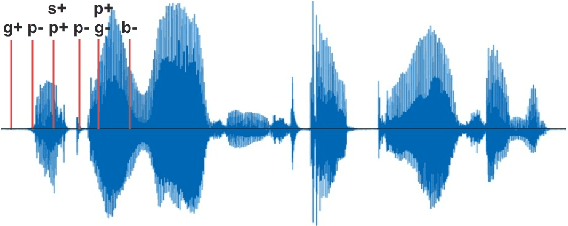
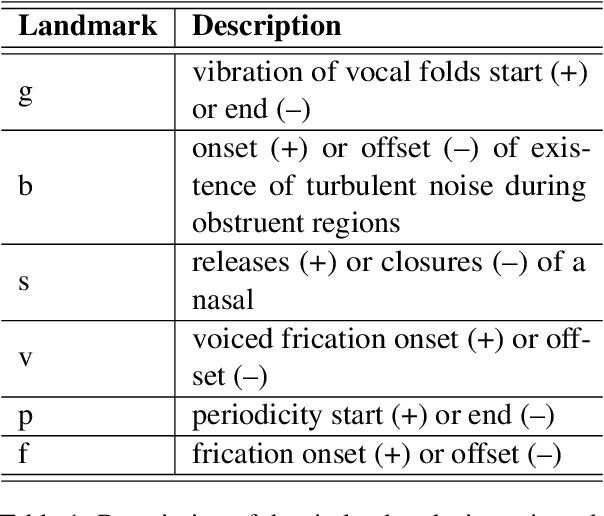
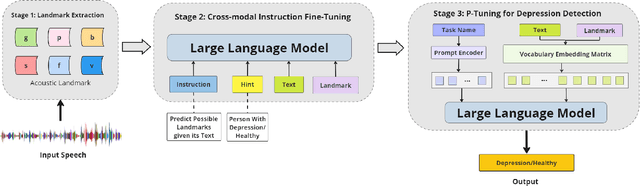

Depression is a critical concern in global mental health, prompting extensive research into AI-based detection methods. Among various AI technologies, Large Language Models (LLMs) stand out for their versatility in mental healthcare applications. However, their primary limitation arises from their exclusive dependence on textual input, which constrains their overall capabilities. Furthermore, the utilization of LLMs in identifying and analyzing depressive states is still relatively untapped. In this paper, we present an innovative approach to integrating acoustic speech information into the LLMs framework for multimodal depression detection. We investigate an efficient method for depression detection by integrating speech signals into LLMs utilizing Acoustic Landmarks. By incorporating acoustic landmarks, which are specific to the pronunciation of spoken words, our method adds critical dimensions to text transcripts. This integration also provides insights into the unique speech patterns of individuals, revealing the potential mental states of individuals. Evaluations of the proposed approach on the DAIC-WOZ dataset reveal state-of-the-art results when compared with existing Audio-Text baselines. In addition, this approach is not only valuable for the detection of depression but also represents a new perspective in enhancing the ability of LLMs to comprehend and process speech signals.
Speaking in Wavelet Domain: A Simple and Efficient Approach to Speed up Speech Diffusion Model
Feb 16, 2024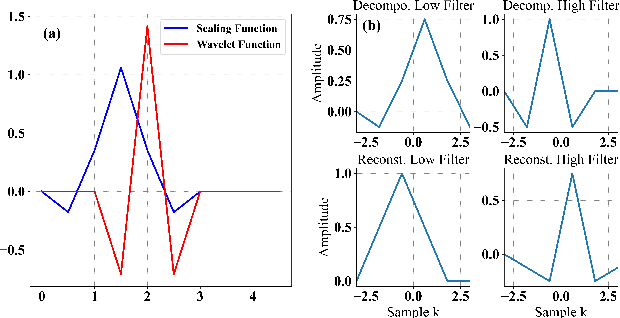
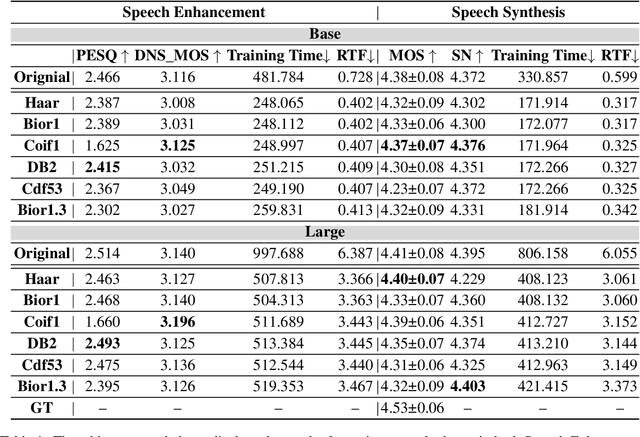

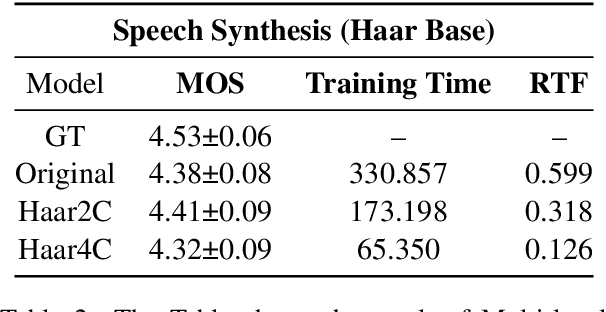
Recently, Denoising Diffusion Probabilistic Models (DDPMs) have attained leading performances across a diverse range of generative tasks. However, in the field of speech synthesis, although DDPMs exhibit impressive performance, their long training duration and substantial inference costs hinder practical deployment. Existing approaches primarily focus on enhancing inference speed, while approaches to accelerate training a key factor in the costs associated with adding or customizing voices often necessitate complex modifications to the model, compromising their universal applicability. To address the aforementioned challenges, we propose an inquiry: is it possible to enhance the training/inference speed and performance of DDPMs by modifying the speech signal itself? In this paper, we double the training and inference speed of Speech DDPMs by simply redirecting the generative target to the wavelet domain. This method not only achieves comparable or superior performance to the original model in speech synthesis tasks but also demonstrates its versatility. By investigating and utilizing different wavelet bases, our approach proves effective not just in speech synthesis, but also in speech enhancement.